Owner News Header
Note from Chief HCV Officer, Cheryl L. Burns
Cheryl Burns Photo

Welcome to Owner News, CHA's bi-monthly e-newsletter. We hope you are enjoying the format and find the information useful as you navigate the ins and outs of the HCV Program. Each issue includes a short how-to, an answer to a common question and a timely program reminder ... plus links to news you may have missed and helpful resources.

How-to: Update Contact Info on HCV Owner Portal
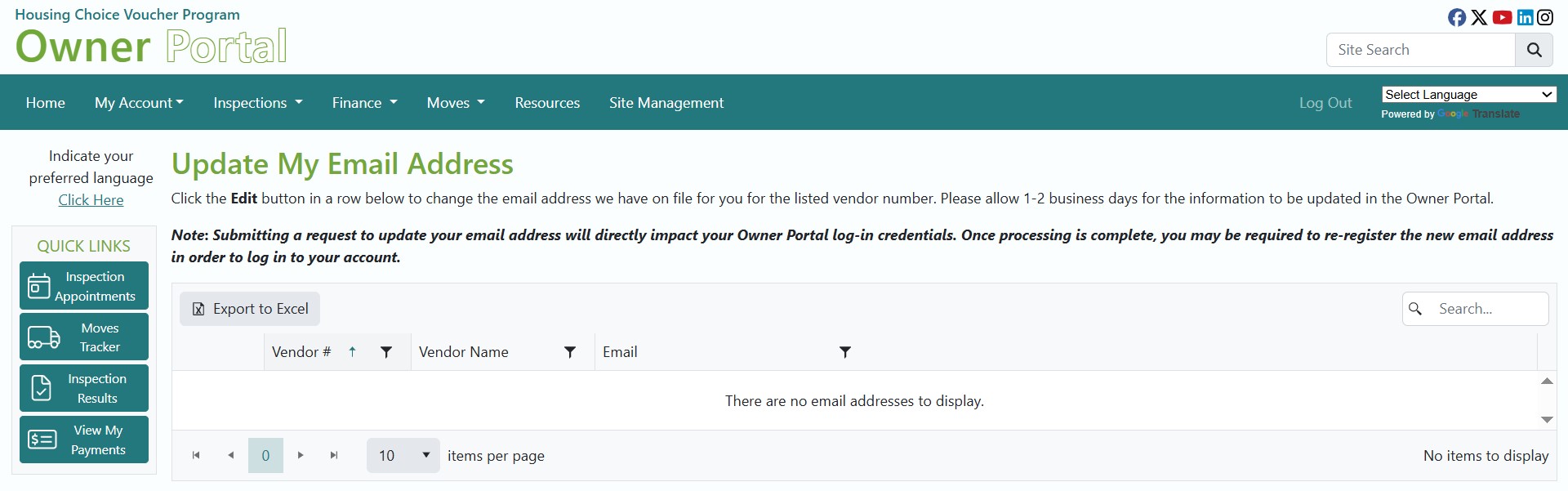
Owner Portal Update My Email Address Screen Image

Did you know that keeping your contact details up to date for your account ensures you receive important updates and communications from CHA? If you need to update your contact information, you can easily make changes on the HCV Owner Portal in just a few simple steps.

To get started, click ‘My Account’ within the site menu. From there, you'll have the option to update your phone number, email address* and/or business address. If you have multiple vendor numbers, you can update the associated contact information for each vendor number.

Remember: Please allow 1-2 business days for the change to reflect in your account.

*Submitting a request to update your email address will directly impact your Owner Portal log-in credentials. Once processing is complete, you may be required to re-register your new email address in order to log in to your account.

FAQ Corner: Tenant Screening  

Property owners/managers often ask ... "How should I screen potential tenants?”

Your rental property is a business, and deciding whom to lease it to is a major business decision. It's important that you thoroughly screen a potential tenant (HCV or market-rate) before starting a tenancy and entering into a lease agreement. 

CHA evaluates whether the unit is affordable for the HCV participant, not whether the tenant is a good fit. Therefore, it’s the property owner’s responsibility to screen and select a suitable tenant. Below are some tips to help you choose the right renter for your property.

Know Your Criteria
Make a list of your non-negotiables before you start the tenant screening process. Will you require a minimum credit score? Will you only accept pet-free tenants? How important is rental history? Knowing what your deal breakers are will help you better understand the makeup of your ideal tenant.

Consider Using a Rental Application
Having all prospective tenants complete a rental application can help you gather key information, including employment history, credit background, pet expectations, previous addresses, and contact details for former property owners/managers.

Use a Background Check Service
A background check service can provide more information on potential tenants, including credit, criminal* and eviction histories. A simple internet search can help you find a background check service that aligns with your business goals.

*There are fair housing protections for covered criminal history. The Cook County Just Housing Amendment establishes a three-year threshold for criminal history when screening a prospective tenant to rent a unit. Therefore, a property owner cannot consider criminal history that is more than three years old and must conduct an individualized assessment of any applicant with a criminal history less than three years old.

Stay in Compliance with Fair Housing Laws
When screening tenants, it’s important to comply with fair housing laws that require property owners to apply the same screening criteria to all tenants equally and offer reasonable accommodations to people with disabilities. Combined, Chicago, Cook County, Illinois, and Federal fair housing laws and ordinances prohibit discrimination based on:

  • Race
  • Color
  • National Origin
  • Ancestry
  • Religion
  • Age
  • Disability
  • Sex
  • Gender Identity
  • Marital Status
  • Covered Criminal History
  • Familial Status
  • Sexual Orientation
  • Military Discharge
  • Housing Status
  • Source of Income

In addition, property marketing must comply with fair housing laws. For example, using language such as "Section 8 Welcome" or "Adults Only" on a property listing would be considered a fair housing violation as it indicates a preference and is exclusionary.

Interview Potential Tenants
Connect with potential tenants to get a sense of their lifestyle and rental background. These conversations can take place virtually or in person. Below are some questions you may want to ask a potential tenant during an interview:

  1. Why are you looking to move?
  2. Do you or any other occupants smoke?
  3. Is there anything else I should know about you and your living situation?
  4. Do you have any questions for me?

Verify Information
Confirm that the information a potential tenant provides on their rental application is correct. Contact their references. Confirm their employee status with their employer. Contact former property owners/managers to learn more about what they were like as tenants.

Reminder: CHA can provide contact information for a voucher holder's current and/or previous HCV property owner/manager.

Timeline for a Rent Increase Request  

If you're considering submitting a rent increase request to CHA, make sure to provide the HCV participant family proper notice as required by the Chicago Residential Landlord Tenant Ordinance (RLTO). The amount of notice is dependent on how long the family has resided in the unit:

  • If the family has lived in the unit for less than 3 years, you must notify them 60 days prior to the desired effective date.
  • If the family has lived in the unit for over 3 years, you must notify them 120 days prior to the effective date.

When you're ready to request a rent increase, you must submit it via the HCV Owner Portal. Simply log in to your account, click on 'Finance' within the site menu and select ‘Request a Rent Increase’ from the drop-down list. Then, carefully read through the overview and follow the instructions on the screen. Once successfully submitted, CHA will review and either approve or deny the request within 30 days of receipt.

Program Reminder: Best Practices for Submitting an RTA Packet 

A complete and accurate Request for Tenancy Approval (RTA) packet is what officially starts the leasing process in the HCV Program and allows the participant family to move into your unit. Missing, incorrect or incomplete information may result in processing delays and require further action.

Take It One Page At a Time
The RTA packet is 18 pages long and consists of the following:

  • Instruction Pages (page 2 must be completed and submitted to CHA)
  • HUD Request for Tenancy Approval (RTA)
  • Authorization for the Release of Information (individual property owners only)
  • Lead-Based Paint Disclosure
  • Direct Deposit Authorization & IRS Form W-9 (new HCV property owners only)
  • Affidavit of Ownership
  • Property Owner Certification
  • Management Authorization (if applicable)

You don’t necessarily need to complete every single page as some pages only apply to property owners who meet certain criteria. However, you should carefully read through each page to ensure you’re providing applicable information as requested.

Include Supporting Documentation
Property owners must register for direct deposit in order to receive the Housing Assistance Payment (HAP) from CHA. The Direct Deposit Authorization form is included in the packet along with instructions as to what is required to accompany the form (i.e., voided check, letter from the financial institution).

Submit to the Correct Place
Existing HCV property owners can submit RTA packets directly on the HCV Owner Portal.  After you log in to your account, click on 'Moves' within the site menu and select 'Upload my RTA' from the drop-down list.

New property owners can submit by email to ownerinfo@thecha.org.

Note: Submission to any other CHA email address or inclusion of other CHA email addresses in the To: or CC: line will only delay processing.

When in doubt, contact CHA.
Are there certain forms or fields you need clarification on? Contact the HCV Owner Services Department at ownerinfo@thecha.org for assistance. You can also schedule an appointment to visit the Owner Services Department in person at CHA’s Central Office location (60 E. Van Buren).

Image of CHA CEO Keith Pettigrew outside CHA headquarters
Welcome CHA's New CEO

On April 21, 2026, Keith Pettigrew started his new role as Chief Executive Officer of CHA. Pettigrew previously served as the Executive Director of the Washington, D.C. Housing Authority and has over 20 years of experience in the housing industry. “It is an honor to step into this role and serve the people of Chicago,” Pettigrew said.

“I grew up in public housing, so I know what access to safe and stable housing can mean for people. Chicago has a lot of work ahead, but there’s also a tremendous amount of opportunity right now, especially when it comes to strengthening core operations and investing in development on the South and West Sides. I’m ready to hit the ground running and work hand in hand with resident leaders, the City of Chicago, elected officials, CHA’s staff and Board, and every partner who cares about this mission. We’re going to focus on getting the basics right, expanding affordable housing, and making sure residents feel heard, respected, and supported. That’s the standard I’m holding myself to, and that’s the future I’m excited to build together.”

Click here to learn more about CEO Pettigrew as he begins his tenure at CHA.

Health & Wellness Corner: PTSD Month  

June is PTSD Awareness Month image

June marks Post-Traumatic Stress Disorder (PTSD) Awareness Month. Approximately 12 million people in the United States have PTSD. PTSD develops after experiencing a traumatic event such as a natural disaster, combat, sexual assault, or a serious accident.

PTSD Month is dedicated to spreading the word of how PTSD treatment works and how effective treatments can help reduce symptoms and lead to a better quality of life. PTSD symptoms fall into four main categories:

Reliving or re-experiencing the event. You may have nightmares, flashbacks (where you feel like you’re reliving the event), or trauma reminders like places, sounds, or smells that cause distress.

Avoidance. You may avoid things, places, or people that remind you of the event. This might mean keeping busy to avoid thinking about the trauma or staying away from people because you feel it’s just easier to be alone.

Negative changes in feelings and beliefs. You may notice changes in the way you think about yourself and others, you might feel guilt or shame about the traumatic event or lose interest in things or people you used to enjoy.

Hyperarousal or being on guard. You may feel keyed up or on edge, have a difficult time focusing, or feel as if you are “on alert” for danger more often.

Visit www.ptsd.va.gov for more information, including understanding PTSD, treatment options, friends and family support, and more.

Upcoming Events  

A Guide to Leasing Up with the HCV Program
Tuesday, June 16, 1 p.m. to 2:30 p.m. | Register Now

Get an overview of the full leasing process as a property owner in the HCV Program. We’ll clarify key CHA policies and procedures and review tips to help you lease up smoothly and efficiently.

Ensuring Equity: The Importance of Fair Housing Protections
Tuesday, June 23, 1 p.m. to 2:30 p.m. | Register Now

Hear from legal experts as they break down federal, state, and local Fair Housing laws. You’ll learn how to recognize potential violations, understand your rights and responsibilities, and how to support equitable housing practices in your community.

Save the Date: 2026 CHA Owner Symposium
Thursday, October 29, 9 a.m. – 3 p.m. | In Person and Online

The Owner Symposium is CHA's premier event for Chicago property owners, managers, investors and other real estate professionals. Now in its 17th year, this day-long event will be held at CHA Headquarters and feature three general sessions covering timely industry topics, a dedicated exhibit area with products and services from a variety of vendors, and opportunities to connect with other Chicago housing providers.

Registration is scheduled to open this summer, and space for the in-person event will be limited. Visit chaownersymposium.org for the most up-to-date information and click here to view highlights from last year’s event.

Resources for Property Owners 
Photo of a staff meeting in a conference room

HCV Webinars are available on-demand!

Dozens of recorded sessions are available for you to watch anytime, including: Equitably and Suitability: Understanding the Tenant Screening Process, Lease Writing 101, Communication and Mediation: The Key to Having a Healthy Relationship with Your Tenant and many, many more!

We want to hear from you! Especially if you’ve never attended one of our educational sessions before ... please take a minute to share what you'd like to see from HCV education and events.
TAKE THE SURVEY

Have leasing-related questions, or want to request a 1:1 consultation? The HCV Owner Outreach team is here to help. Email owneroutreach@thecha.org. ¡También ofrecemos estos servicios en español!

In Case You Missed It:

More Housing Ahead: CHA Board Approves 94 New PBVs
Ukrainian Village, Bucktown Apartment Proposals Approved By City Council
Advocate Health Care breaks ground on new Trinity Hospital building in South Chicago

Photo of a stack of books
HCV Online Resources to Bookmark

Affordability Calculator (for non-Mobility area units): chahcvportal.org under the 'Moves' menu.

Search the interactive Mobility Area Map: thecha.org/mobility and scroll to the bottom.

Add comparable units to CHA's rent reasonableness database: AffordableHousing.com (free account required), log in and click 'Comparables' in the left-hand menu.

View/download HAP Statements or submit a rent increase request: chahcvportal.org under the 'Finance' menu.

Thanks for Reading  

We appreciate your continued partnership! If you liked this newsletter, or have topic suggestions for newsletter articles or webinars, reply to this email and let us know.

Looking for past editions of Owner News? Find them on the HCV Owner Portal at chahcvportal.org, under the 'Resources' menu.

 
 Facebook  X / Twitter  Linkedin  Instagram  Youtube

Chicago Housing Authority | 60 E. Van Buren Street | Chicago, IL 60605

Unsubscribe